
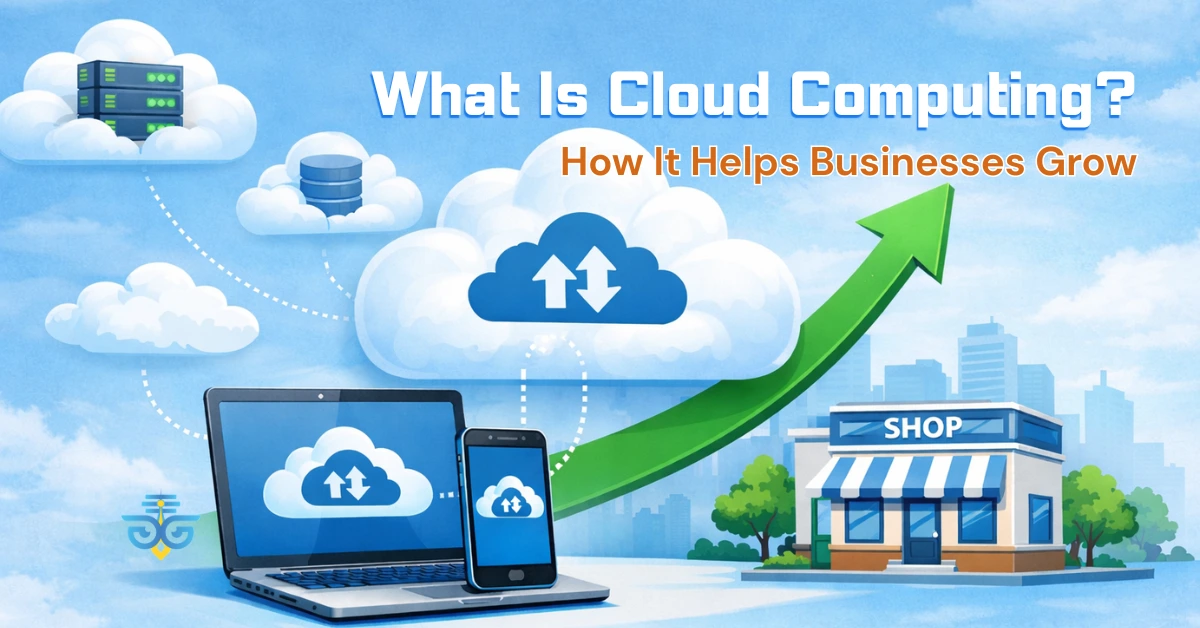
In today’s digital-first economy, businesses must operate faster, smarter, and more securely. However, traditional IT infrastructure often limits growth. This is where cloud computing for businesses becomes a game changer.
Cloud computing allows companies to store data, run applications, and manage operations over the internet instead of relying on physical servers. As a result, businesses can scale quickly, reduce costs, and improve productivity.
Let’s understand everything step by step.
What Is Cloud Computing?
Cloud computing is the delivery of computing services — including servers, storage, databases, networking, and software — over the internet (the “cloud”).
Instead of buying expensive hardware, businesses rent resources from cloud providers and pay only for what they use.
For example:
- Storing company files online
- Running software without installing it locally
- Hosting websites on cloud servers
- Managing customer data securely
Therefore, cloud computing eliminates the need for heavy upfront IT investment.
Types of Cloud Computing
Understanding the types of cloud computing helps businesses choose the right solution.
1. Public Cloud
Services are delivered over the public internet and shared among multiple organizations.
Best for startups and small businesses.
2. Private Cloud
Dedicated cloud infrastructure for a single organization.
Ideal for businesses requiring higher security.
3. Hybrid Cloud
A combination of public and private cloud systems.
Suitable for growing companies that need flexibility.
Key Benefits of Cloud Computing for Businesses
1. Cost Efficiency
Traditional IT infrastructure requires hardware purchase, maintenance, electricity, and staff. However, cloud computing works on a pay-as-you-go model.
As a result:
- Lower operational costs
- No expensive hardware upgrades
- Reduced maintenance expenses
2. Scalability and Flexibility
Business demand changes constantly. During peak seasons, you may need more resources. On the other hand, off-seasons require less.
Cloud computing allows businesses to scale up or down instantly. Therefore, companies can grow without technical limitations.
3. Improved Security
Many business owners think cloud systems are risky. However, top cloud providers offer advanced security features like:
- Data encryption
- Multi-factor authentication
- Regular backups
- Firewall protection
Consequently, your data often becomes safer than traditional systems.
4. Remote Accessibility
Today, remote work is common. Cloud computing allows employees to access data from anywhere using secure login credentials.
As a result:
- Improved collaboration
- Faster communication
- Higher productivity
5. Automatic Updates and Maintenance
With traditional systems, businesses must manage software updates manually. However, cloud services update automatically.
Therefore:
- No downtime
- Better performance
- Always up-to-date systems
How Cloud Computing Helps Small Businesses
Small businesses benefit the most from cloud computing.
First, they can launch websites and apps without investing in servers.
Second, they can use CRM tools and accounting software online.
Finally, they can scale operations as they grow.
Because of this flexibility, even startups can compete with large enterprises.
Real-World Business Applications
Here are common ways businesses use cloud computing:
- Website hosting
- Email services
- Data backup and disaster recovery
- E-commerce platforms
- Online collaboration tools
- Customer relationship management systems
In addition, cloud technology supports AI tools, analytics, and automation.
Why Businesses Should Move to the Cloud in 2026
Technology is evolving rapidly. Meanwhile, competition is increasing in every industry.
Businesses that rely only on traditional systems struggle with speed and innovation. On the contrary, companies using cloud computing adapt faster and operate more efficiently.
Therefore, cloud computing is no longer optional – it is essential for growth.
Final Thoughts
Cloud computing for businesses is transforming how companies operate. It reduces costs, increases security, improves flexibility, and supports long-term growth.
If your business still depends on traditional infrastructure, now is the right time to switch. The sooner you adopt cloud solutions, the stronger your competitive advantage becomes.
At Nilanki’s World, we help businesses build secure, scalable digital systems that support growth in the modern era.